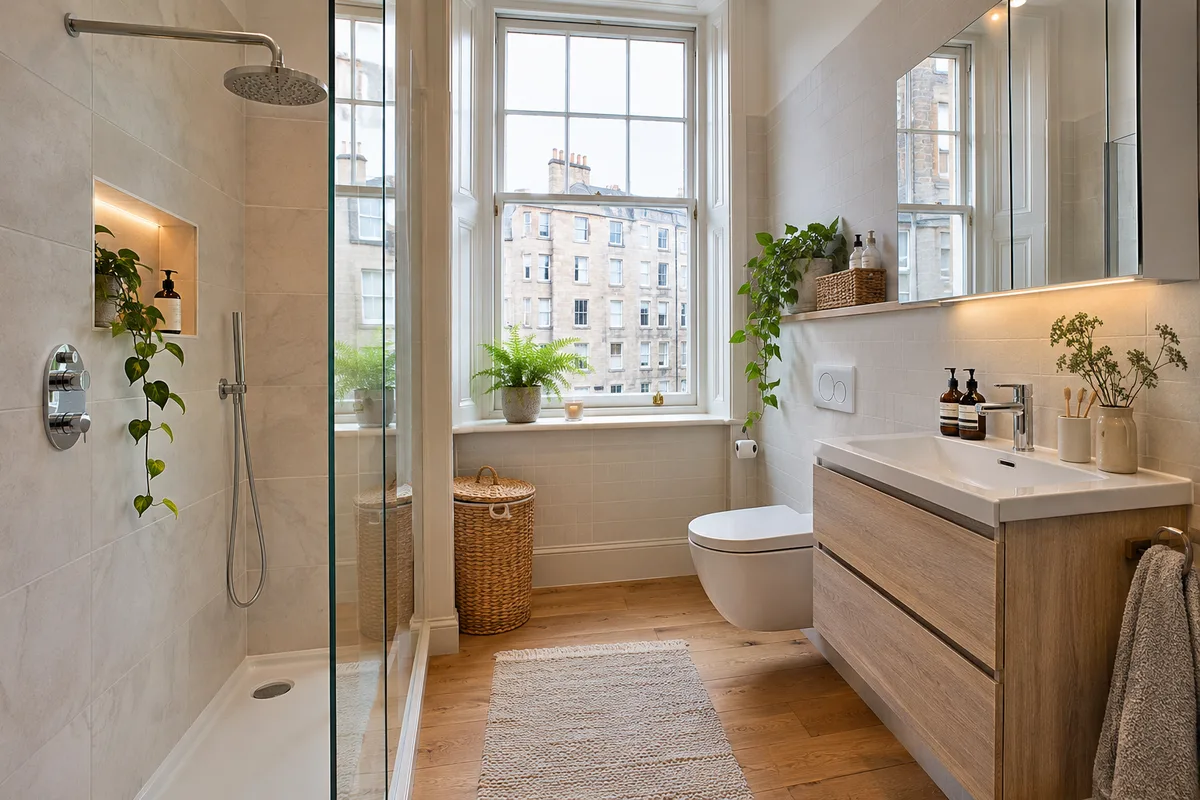
These small bathroom tips come from years of refitting tight rooms in old flats. A small bathroom is a run of small decisions, made in the right order. This guide goes through them in that order, with the tricks we use ourselves and a link to the detailed guide on each topic. If you want the full process first, start with our tenement bathroom renovation planning guide.
Decide what the room must do before choosing anything
Start with who uses the room, not with tiles. A bathroom for a couple who shower in the morning is a different job from a bathroom for a family with young children. Write down what you do in there, and what annoys you now.
Is this your only bathroom? If so, the room has to work for everyone, every day. Our guide to renovating your only bathroom explains why that changes the plan.
Do you need a bath? If nobody uses it, you may be giving up space for nothing. Ideas for young children in a flat and for older or less mobile people start from different needs, so decide which applies to you.
Set a budget early. Our guides to small bathroom ideas on a budget and what a small bathroom renovation costs show where the money goes, and our page on bathroom costs gives the overview. We fit bathrooms from £3,995.
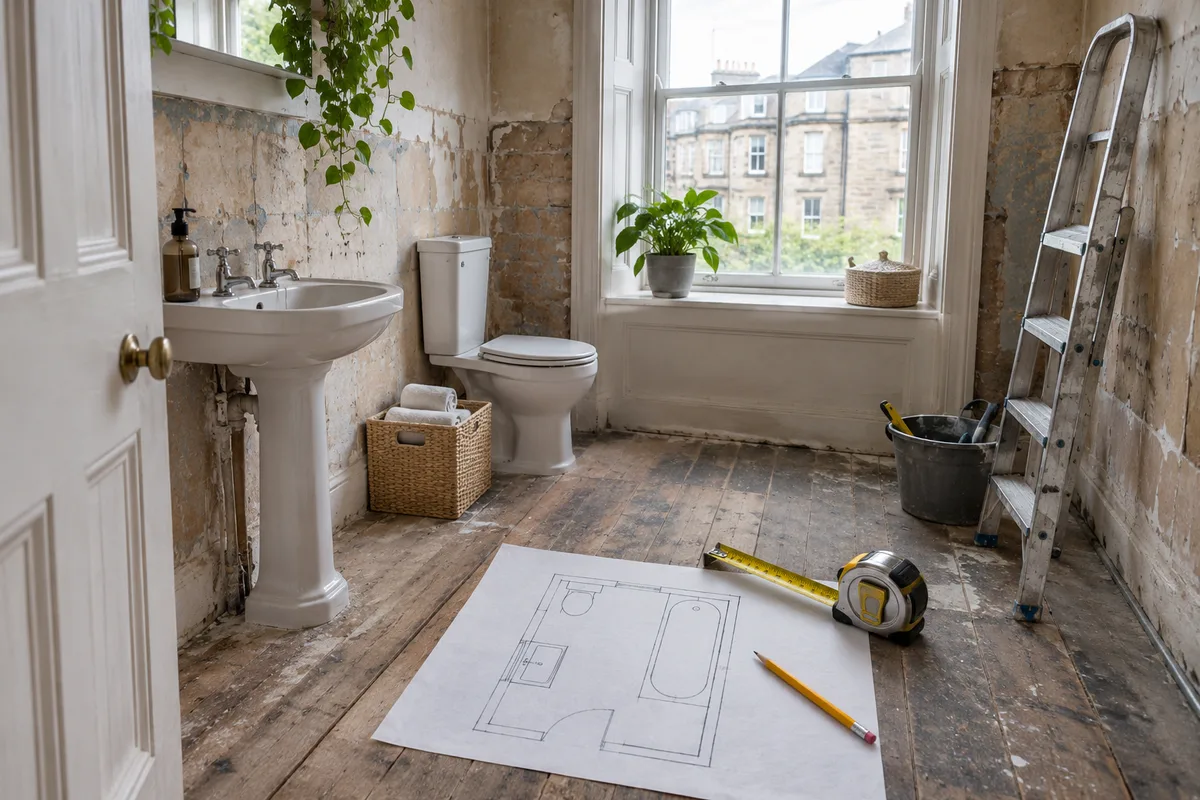
Layout decisions: what to move and what to leave
The cheapest layout is usually the one that keeps the toilet where the soil pipe already is. Moving a toilet is possible, but it depends on the pipework and the floor. Before you ask for it, read about moving a toilet in a tenement bathroom. In many buildings the main stack is shared, so also check what you can change on a tenement soil stack.
Choose wall-hung fittings where you can. When you can see floor under the toilet and vanity, the room looks bigger and is easier to clean. There is a cost and a pipework trade-off, which our guide on wall-hung or floor-standing toilets sets out.
Pick a shallow-depth basin for the wall nearest the door. It can save a hand's width of floor. See small bathroom basin ideas for compact, corner and semi-recessed options.
A separate toilet and bathroom can sometimes become one useful room. Our guide explains joining a toilet and bathroom into one room, and a spare cupboard might even become a tenement ensuite.
Pipes in the wrong place can often be hidden. Look at boxing in pipes before you decide a stack rules out your layout.
If you want a second opinion on the plan, book a free survey of your bathroom and we will measure it with you.
Bath, shower or both
This is the biggest decision in a small room. A walk-in shower usually gives more usable space than a bath. A bath is still the right answer for many families.
If you are weighing the two, start with bath or walk-in shower for your tenement. If you want to remove the bath, see our bath to shower conversion page and the guide to converting a bath to a shower in a tenement. For a walk-in layout, look at our walk-in shower installation page and the walk-in shower ideas for small bathrooms.
Our guide to small bathroom ideas with a bath shows how. A shorter bath, or a shower bath with a screen, often fits where a standard bath will not. A corner bath is another option. It can keep a bath in a room that is too short for a straight one, as long as there is a free corner and enough room to step round it. Tape it out on the floor first.
If you want a level-access shower with no tray, our page on wet rooms for tenement flats and the guide to whether your flat suits a wet room explain what the floor must be able to do. Compare it with a tray in wet room or shower tray.
Choose the shower valve position before the tiles. Put it where you can turn it on without stepping into the spray. Then pick the enclosure style with the help of our guide to small bathroom shower enclosures.
Walls, floors and finishes that last in an old building
Look at what is behind the wall first. Many older flats have lath and plaster, and the right choice depends on its condition. See lath and plaster bathroom walls.
Tiles or panels is a real choice, not just a style one. Compare them in wall panels or tiles for a tenement. If you already have tiles, our guide on wall panels over existing tiles explains when you can cover them and when they must come off. Where you do tile, small bathroom tile ideas covers size, layout and grout.
The floor takes the most punishment. Boards flex and tiles crack when the base is not right. Read replacing a bathroom floor in a tenement and compare materials in bathroom flooring for older flats.
Use a niche in a stud wall, not an external wall, for shampoo. A niche in an external wall can get cold and wet. Storage ideas are in small tenement bathroom storage and small bathroom storage cabinets.
Tricks that make a small bathroom feel bigger
Use one large mirror instead of several small ones. It reflects the window and doubles the light. Our guide to small bathroom lighting and mirrors goes into more detail.
Keep the colours light and the finishes few. See decorating a small bathroom for colour and panel ideas.
Choose clear glass over a curtain, so the eye travels to the far wall. In older flats you can keep character and still look fresh. Our guide on modern bathrooms with period character shows how, and our bathroom styles page shows what is on offer. For traditional taste, see Victorian style bathrooms for a tenement.
If you have a tall room, use the height. Our guide to high ceiling bathrooms covers warmth, lighting and keeping the cornice. For more ideas, browse small tenement bathroom ideas and our before and after gallery. If you want something ready to compare, ask for a free tenement bathroom quote and we will talk you through the options.
Water, waste and air: the tenement checks people forget
Keep an access panel for the stopcock. If a pipe ever fails, you want to reach the valve in seconds, not after cutting a tile. If your pipes are old, read about old lead pipes and stopcocks before you close up the walls.
Check the water pressure before you buy a shower. A shower that needs high pressure will disappoint on low pressure. See shower water pressure in a tenement and compare electric and mixer showers.
Fit an extractor with an overrun timer. It keeps running after you leave, and clears the steam that causes mould. If there is no outside wall, ducting an extractor with no outside wall explains the options. A room with no window needs extra care, as described in windowless bathroom ventilation.
Our guide to heating a small tenement bathroom covers towel rails and underfloor options.
Know your obligations. Some changes need a building warrant, and shared parts such as the stack and the roof involve your factor and neighbours. Our guides to building warrants and permissions and the factor and neighbours explain who to tell. If you are on the top floor or in a listed building, read top-floor bathroom renovation and listed building bathroom renovation.
Buying your own suite or one firm to supply and fit
You can buy your own suite from a showroom and hire a fitter. Or one firm can supply and fit everything. Both work, but the risk sits differently.
When you buy the suite yourself, you are the customer of the shop and the fitter is a separate job. If a part arrives damaged, the shop deals with it. If a part is the wrong size, you may have to arrange the return and wait for a replacement, and the fitter cannot start until it arrives. If the fitter damages something, that is between you and the fitter. When the fault could be either, you can end up in the middle.
With one firm supplying and fitting, there is one point of contact. We order the parts, check them when they arrive and fit them. If something is wrong, it is our job to put it right.
Whichever way you go, do these things.
Ask about delivery before you pay. Know the date, and whether it goes to your door or stops at the close.
Check everything when it arrives. Open the boxes and look for chips, cracks and missing fixings. Note any damage in writing straight away.
Ask about returns before you buy. Many shops will not take back items that have been opened, cut to size or made to order. Find out in writing what the shop will take back, and for how long.
Order everything before strip-out. Do not pull out the old bathroom until the new fittings are in your hallway and checked. Otherwise you may be without a bathroom while you wait for one missing part.
Ask for the guarantee in writing. Ours is a 2-year workmanship guarantee. Our guide to bathroom renovation quotes shows what to compare, and our page on bathroom finance explains how spreading the cost works. See also bathroom renovation on finance, and, if cost is the barrier, bathroom adaptation grants in Scotland for accessible bathrooms.
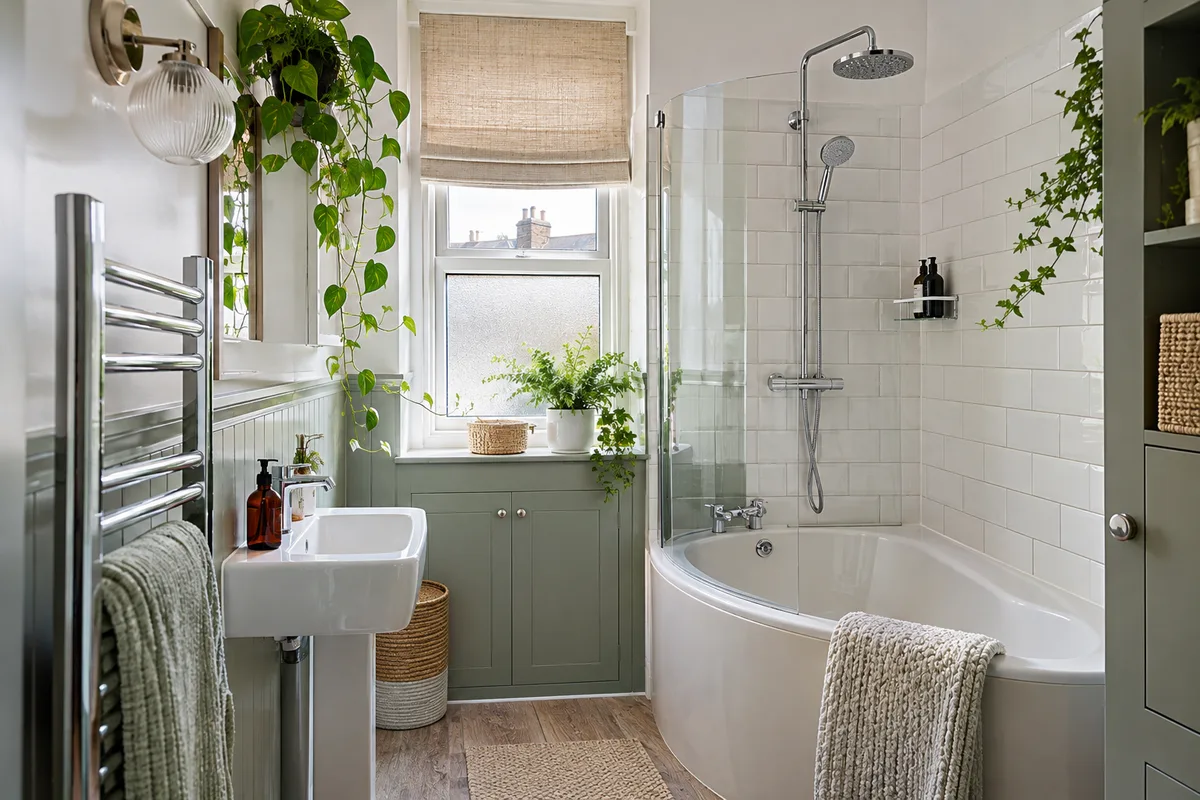
How long a bathroom lasts and when to replace it
There is no single answer. How long a bathroom lasts depends on the quality of the work, how well the room is ventilated, and how the building moves. So we do not quote a number of years. We look for signs instead.
These signs tell you the room is near the end.
Failing seals. Silicone that has split, peeled or gone dark around the bath or tray lets water behind the finish. Fresh silicone over old mould does not fix it.
Mould behind the silicone. If it comes back within weeks of cleaning, water is getting in or the room is not drying. Read damp and mould in a small bathroom before you redecorate.
Cracked or flexing trays and baths. A tray that moves underfoot, or has a hairline crack, can leak without you seeing it.
A spongy or sagging floor. Soft boards around the toilet or bath often mean a slow leak.
Loose or hollow tiles. These often mean moisture behind them.
A stain or leak in the ceiling of the flat below. This is the most serious sign. Act at once. Our guide on a tenement bathroom leaking into the flat below explains what to do and what it means for the refit.
One of these alone may be a repair. Several together mean it is time to replace the room. Our tenement bathroom renovation page shows how we do it.
Small bathroom mistakes we see most
Each mistake comes with its fix.
Buying the fittings before measuring. The fix: measure at two heights, tape the plan out on the floor and only then order.
Choosing a big vanity because it looks good in the showroom. The fix: pick a shallow-depth basin and check the door swing.
Forgetting where the pipes and valves go. The fix: choose the shower valve position before the tiles, and plan the pipework with your fitter.
Skipping ventilation. The fix: fit an extractor with an overrun timer, and ducting that really reaches outside.
Tiling over a problem. The fix: sort out damp, movement and the old walls first. Our tenement bathroom ideas guide shows what suits older buildings.
Boxing in the stopcock. The fix: leave an access panel.
Ignoring the neighbours and the factor. The fix: tell them early, and check whether a building warrant is needed.
Choosing on price alone. The fix: compare what each quote includes, as set out above. Our small bathroom renovations page shows how we plan tight rooms.
Living through the refit
Most bathrooms are fitted in 3 to 7 days. That is short, but if it is your only bathroom, plan the days carefully.
Here is what helps.
Plan the only-bathroom weeks. Arrange a shower at a gym, a friend or a relative. Decide where toothbrushes and towels will live. Our guide to bathroom renovation timescales sets out what happens when.
Clear the way. Protect the stairs and common areas, and tell neighbours when the noisy work is due.
Be around at the strip-out, when surprises such as old pipes or soft boards show up.
If you are ready to talk, ask for a free tenement bathroom quote and we will look at your room and give you a clear plan.
Guidance reviewed 14 November 2026. Technical and permission requirements depend on the property and proposed work; relevant guidance is linked in the article.