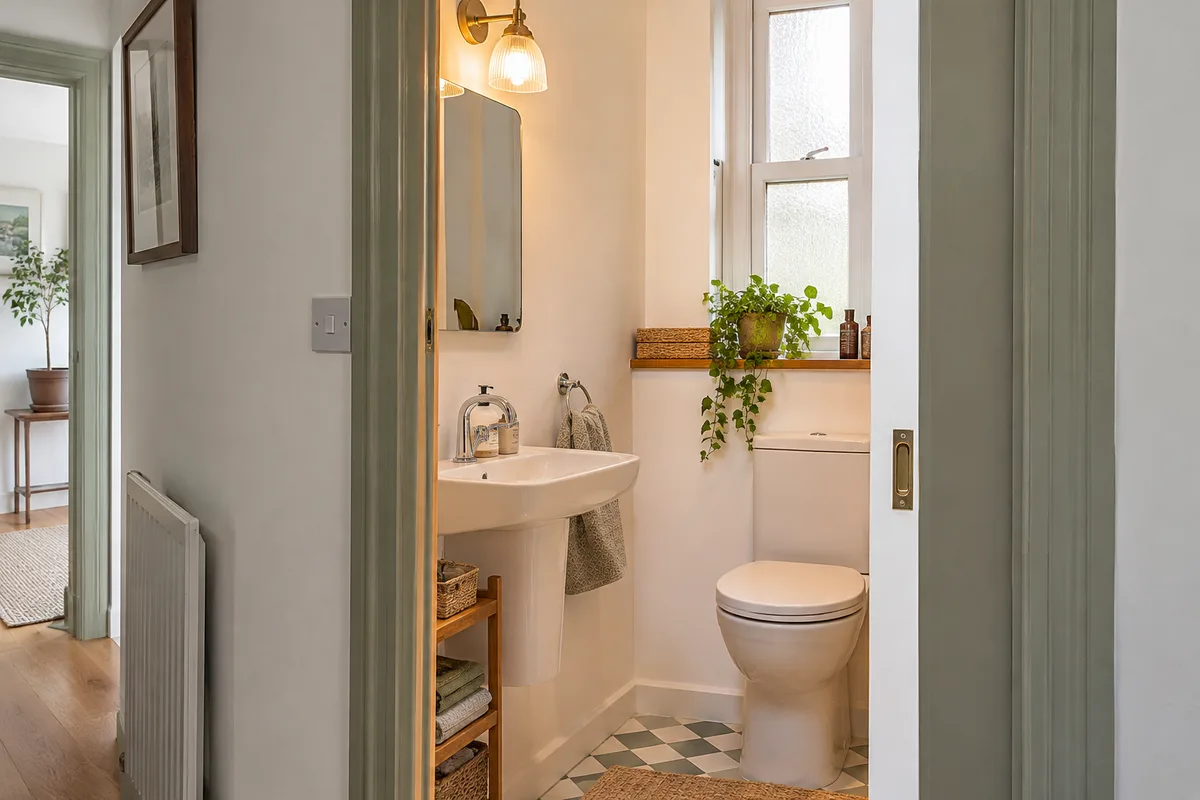
In a small tenement bathroom, the door can take more floor than the toilet. Changing how it opens can free up space without moving a single fitting. This guide compares outward-opening, pocket, sliding and bifold doors, so you can see which one suits your hall and your walls.
How much floor the door swing really takes
A door that opens inwards sweeps a half circle across the floor. Nothing can stand in that area, or the door will hit it. In a small room, that arc often takes the space where a basin, a toilet or a bath end would otherwise sit. Measure the door width, then picture it opening: that is the floor you lose.
Stand in the room with the door open and look at where it stops. If it hits the toilet or the basin, it is already limiting the plan. Many owners only notice this when they try to fit a bigger shower or a vanity unit. Our guide to very small bathroom ideas shows how to measure clear floor before you start.
Rehang the door to open outwards
The simplest change is to rehang the door so that it opens into the hall. It keeps the door you have, so there is no new opening and no wall to cut. The floor inside is then free for fittings. It also helps safety, because the door can no longer be blocked by someone who has fallen inside.
The catch is the hall. The door will now swing into it, so check that it will not hit another door, a radiator or a person walking past. In a narrow hall, it can be worse than the problem it solves. You may also need to move the hinges and refit the lock plate, and the frame will need making good. A joiner can usually do this neatly. If the hall is tight, try one of the other options below.
Pocket doors: when the wall can take one
A pocket door slides into a hollow space inside the wall, so it needs no swing at all. It is the neatest option when it works. The wall must be thick enough and free of pipes, cables and structural parts. A lath and plaster or timber stud wall is much easier to open up than solid brick or stone.
Before you commit, have the wall opened or checked. Tenement walls often hide things you cannot see from the room. The pocket also needs the full width of the door beside the opening, so you lose a wall section for hanging a cabinet or a radiator. Choose a good quality frame kit, because a cheap one will rattle and jam. A pocket door is a real job, so ask for it to be included in the plan from the start. Our small bathroom solutions page explains how we plan these rooms.
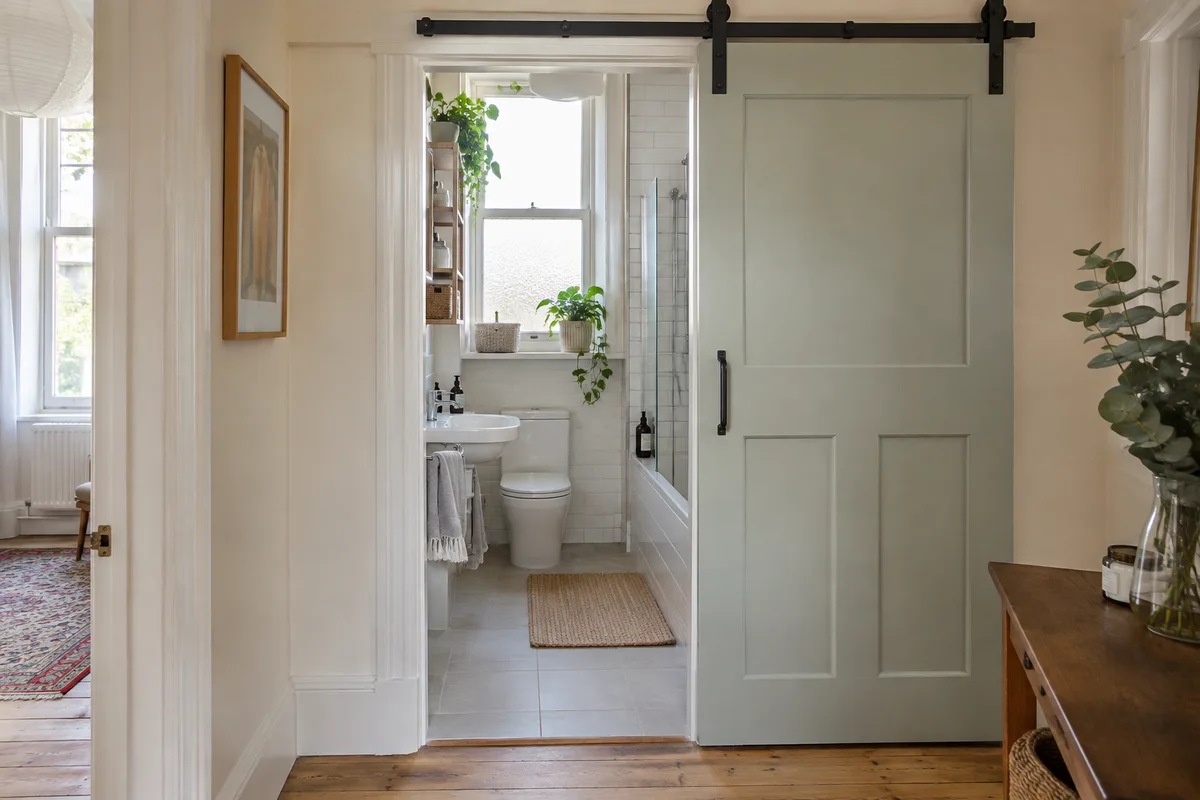
Sliding barn-style doors on the hall side
A sliding door that hangs on a rail on the hall side of the wall needs no pocket. It slides along the wall outside the bathroom and covers the opening when closed. It is a good choice when the wall is solid, or when a pocket would clash with pipes.
You need a clear stretch of hall wall about as wide as the door, so no radiator, picture rail or light switch in the way. The rail must be fixed to something strong. In old walls, that may mean finding a joist or using proper fixings, not just plugs in plaster. A sliding door does not seal as well as a hinged one, so there can be gaps at the sides for sound and steam. A good soft-close fitting and a proper handle help.
Bifold and narrow doors for tight corners
A shower door has the same swing problem, and our guide to small bathroom shower enclosures covers it. A bifold door folds in the middle, so it needs only half the swing of a normal door. It suits a very small room where nothing else fits, though the fold takes up some of the clear width of the opening. A narrower hinged door can also help, but check that you can still get through it comfortably, and carry a laundry basket.
Think about everyone who will use the room. A narrow door may be hard for someone with a walking aid, a pushchair or a bulky item. Our guide to an accessible bathroom in a tenement flat covers this in more detail. In general, the door should not be the tightest part of the journey into the room.
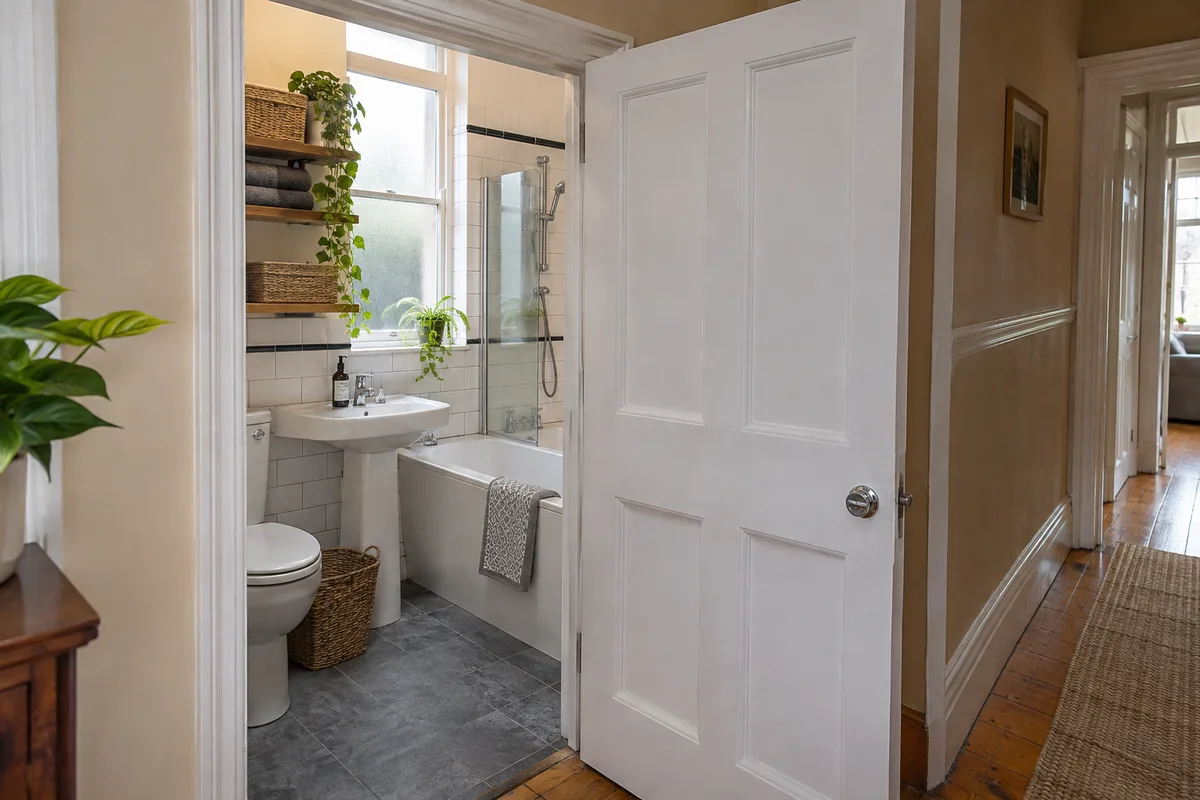
Keeping a period door and its character
Many tenement bathrooms still have the original panelled door, and it is worth keeping. A rehung door keeps its look, while a sliding one can be made from the same timber and paint. Strip and repaint it, fit new hinges and keep the architrave, and it will look as if it has always been there.
If you want to match the rest of the hall, keep the same paint colour and handles. A modern pocket or sliding door can still suit a period flat if the finish matches the woodwork around it. Our guide to narrow tenement bathroom layouts shows how the door fits into the wider plan. Always check with the building owner or conservation rules if your flat is listed.
Locks, privacy and sound
Whatever door you choose, it needs a good lock. A thumb-turn lock is easy to use, and many have an emergency release that opens from outside. That matters if there are children or older people in the flat, so ask before you buy.
Sliding and pocket doors usually let more sound through than a heavy hinged door. If privacy matters, ask for a door with good seals and a solid core, and think about a small extractor so that you do not need to leave the door ajar. A tidy wall unit helps too: see our small bathroom storage cabinets guide for ideas that suit tight walls. If you want us to look at your door and hall, call us or ask for a free quote.
Guidance reviewed 14 November 2026. Technical and permission requirements depend on the property and proposed work; relevant guidance is linked in the article.