A shower enclosure keeps water in, and in a small bathroom the door decides how much room you have left. Quadrant, sliding, pivot and bifold doors all suit different spaces. This guide helps you choose the right one for your tenement bathroom, and explains how to fit it to walls that are not straight.
When an enclosure suits better than a walk-in
A walk-in shower looks clean and open, but it needs space for the spray to land. If your room is very small, a fully enclosed shower keeps the water where it belongs and protects the toilet, the basin and the floor. It is also easier to keep warm, because the steam stays in the cubicle.
An enclosure suits you if the shower sits close to other fittings, or if you want the most reliable protection from splashes. A walk-in works better in a longer room with a clear run. Our guide to walk-in shower ideas for a small bathroom explains when to choose that route, and our walk-in shower installation page covers the wider range we fit.
Quadrant and offset quadrant enclosures
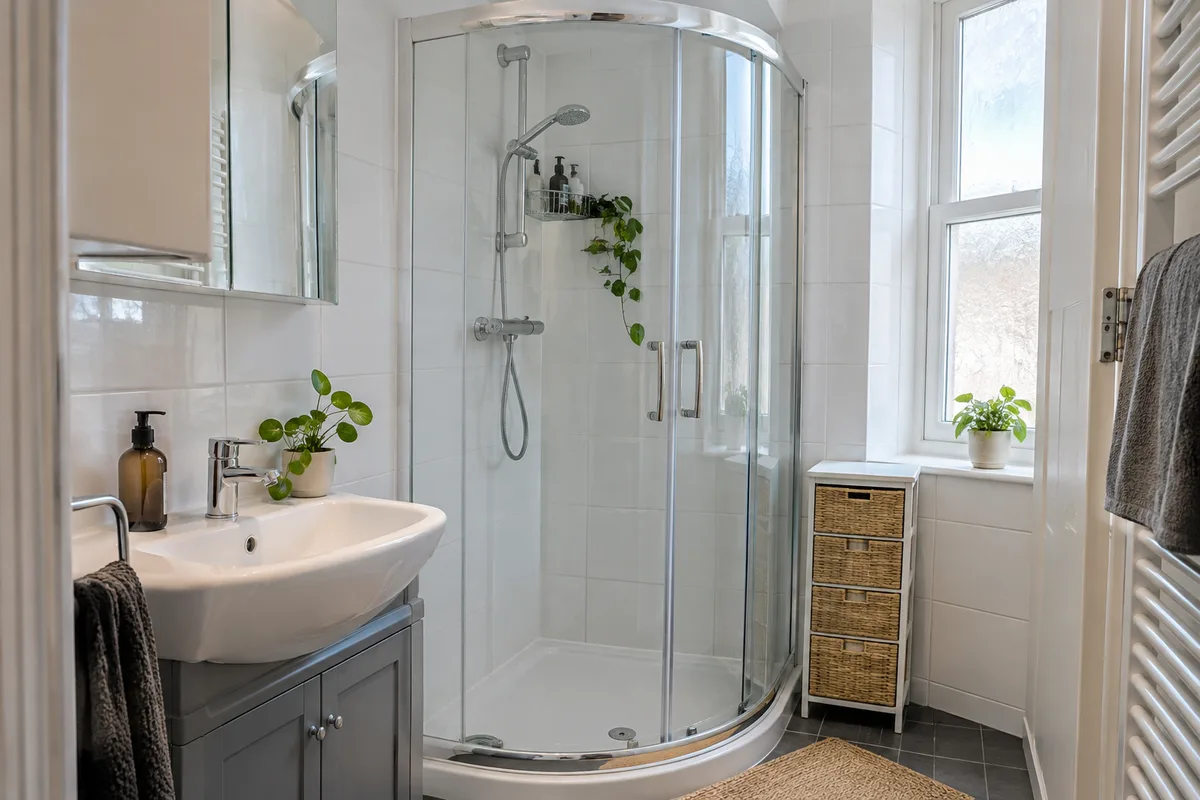
A quadrant enclosure has a curved front, so it fits into a corner and sticks out less than a square one. The curve gives more walking room in front. Most use two sliding doors, so you do not need a swing. They are one of the best choices for the corner of a small bathroom.
An offset quadrant is a flatter shape, with one side longer than the other. It gives more room inside while still rounding off the corner, and it suits a rectangular space. Check the size of the tray carefully. A quadrant inside can feel tighter than the outside suggests, so stand in the space and see whether you can move your elbows. Ask for sizes to be drawn on the plan before you buy.
Sliding doors for narrow rooms
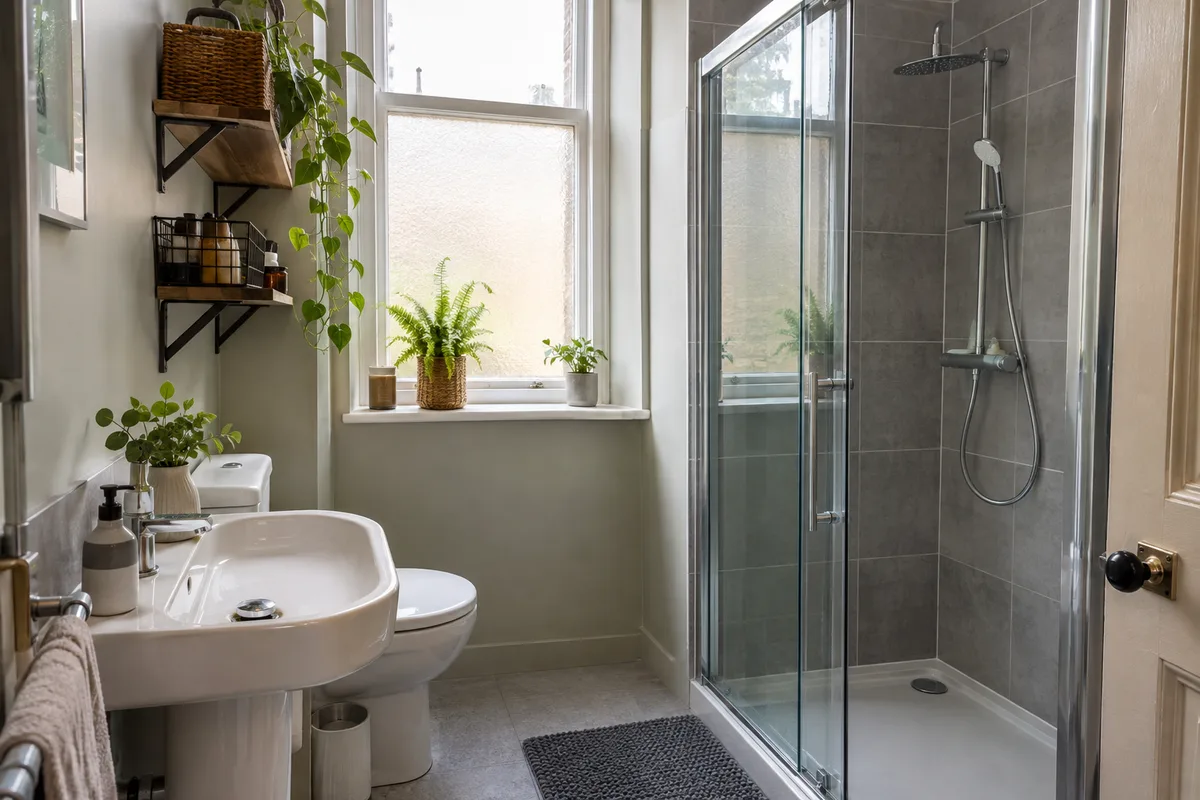
Sliding doors are the safest choice for a narrow room, because they need no swing at all. The door glides along a track, so it will not hit the toilet, the basin or the wall. They suit a rectangular tray along one wall, which is a very common tenement layout.
The trade-off is the opening. Only part of the width is open at any time, so a wide person may find it tighter, and the track needs cleaning. A good enclosure has a smooth runner and a simple way to lift the door out for cleaning. Ask to see the door working. It helps to compare the options against a doorless shower in our guide to a wet room or shower tray.
Pivot and hinged doors: check the swing
A pivot or hinged door gives the widest opening, and it is simple and easy to clean. The problem is the swing. The door must open outwards into the room, so there must be clear floor in front of it, and it must not hit the toilet, the basin or the room door.
Draw the arc on the floor with tape and open the room door as well. If anything is in the way, choose another type. If you are also thinking about changing the bathroom door, see our guide to small bathroom door ideas, because the two doors often compete for the same floor.
Bifold doors for tight corners
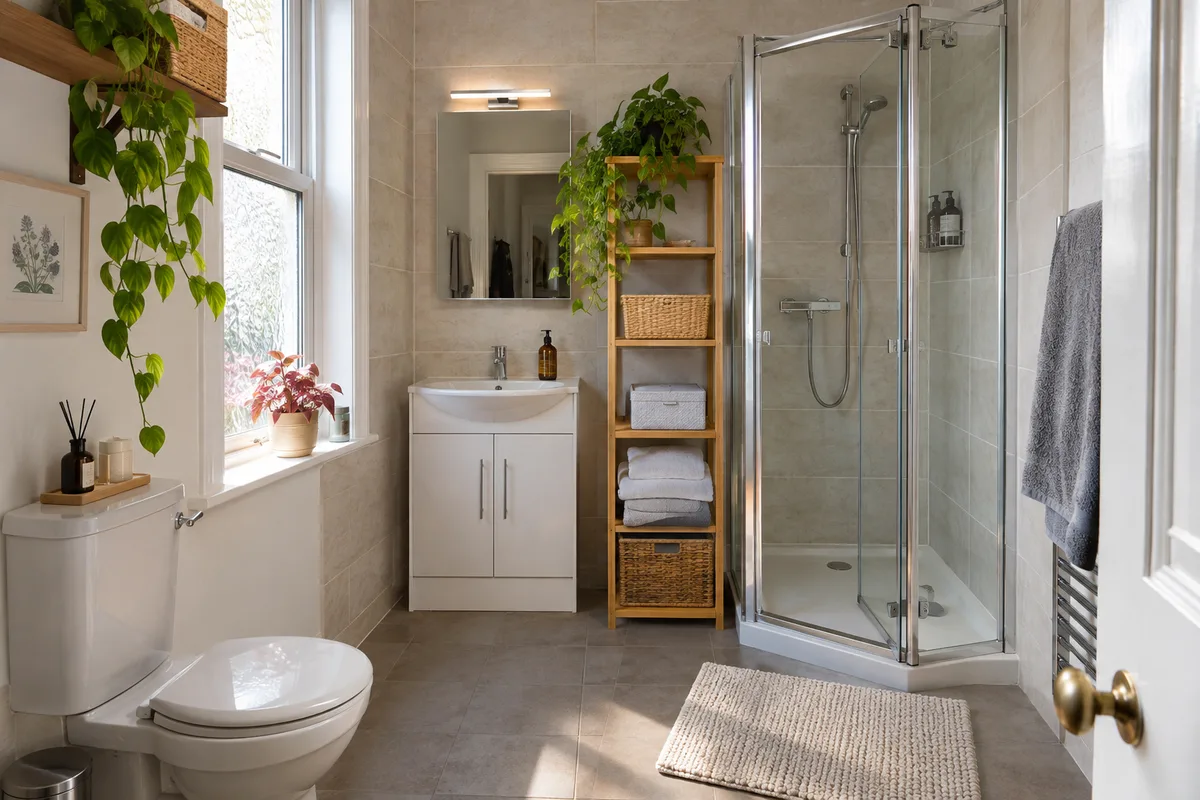
A bifold door folds in two, so it needs very little room to open. It suits a small square tray in a corner where a sliding door would not give enough opening and a swinging door would hit something. It folds back on itself, so the swing is a fraction of a normal door.
The downside is more joints, which means more places for limescale and soap. The panels also take up some of the opening when they are folded. Keep the seals clean and wipe the hinges. A bifold is a smart answer to an awkward fit, but it is rarely the first choice if a simpler door will work. For other ways of using a corner, see awkward-shaped bathroom ideas.
Glass thickness, coatings and cleaning
Shower glass should be toughened safety glass. Ask the supplier to confirm it, and check that the enclosure is made for showers. Thicker glass usually feels more solid and is often used on frameless designs, while thinner glass in a framed enclosure is common and works well. Frameless looks smart but needs careful fitting.
An easy-clean coating helps water run off the glass, but it does not do away with cleaning. Wipe the glass with a squeegee after each shower, and ventilate the room. In a hard water area, limescale will build up if you leave it. Choose a simple frame and straight edges that are easy to wipe. If you have a window in the shower, see our guide to a shower under a window in a small bathroom.
Fitting an enclosure to uneven tenement walls
Tenement walls are rarely straight or square. Plaster bows, corners lean and tiled walls can have a slight twist. An enclosure is made with straight edges, so it must be fitted carefully, or there will be gaps that leak. Good frames have adjustable sides to cope with small errors.
Measure the wall at the top, the middle and the bottom before you order. Tell us if the wall is out of true. A quality sealant then closes the final gap, and the tray must be set level so the doors run properly. For the bigger picture, see our guide to a bath to shower conversion in a tenement. If you want us to measure up and advise, call us or ask for a free quote.
Guidance reviewed 14 November 2026. Technical and permission requirements depend on the property and proposed work; relevant guidance is linked in the article.