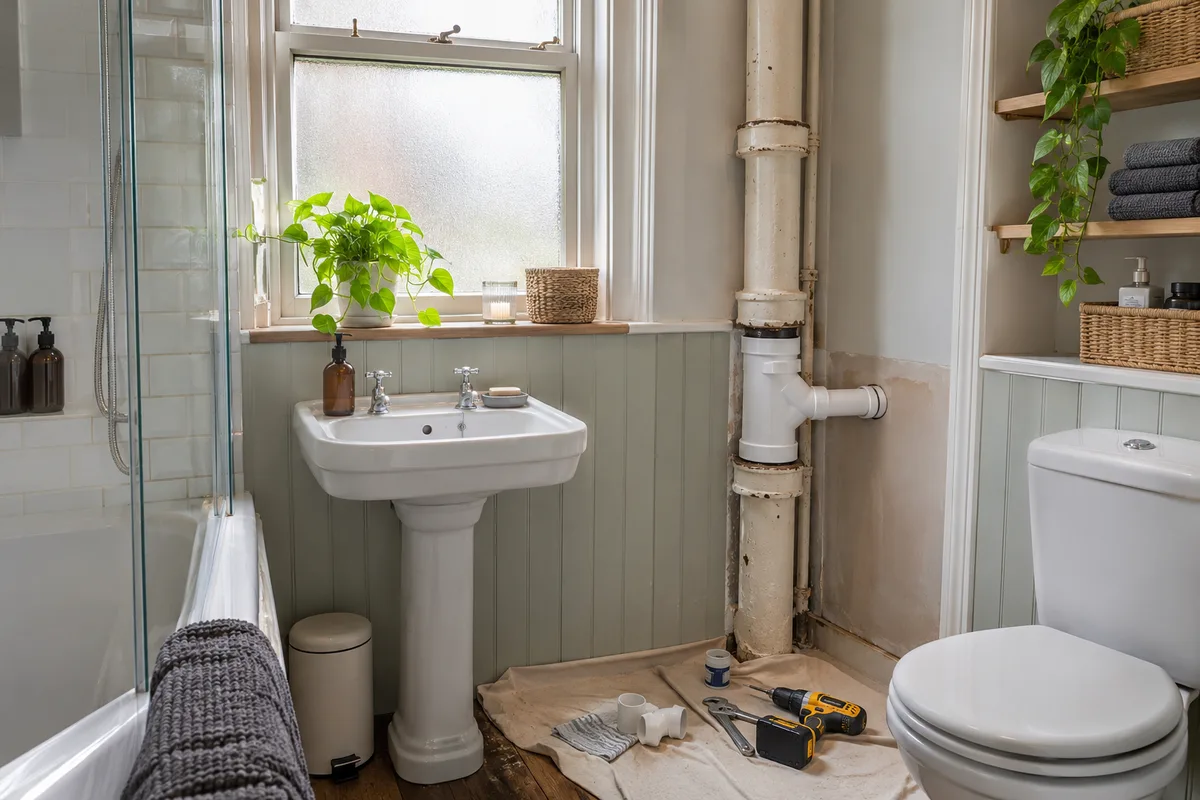
The tenement soil stack is the large vertical pipe that carries waste from every flat above and below you down to the drain. Because it serves the whole stair, it is not quite yours to do what you like with. This guide explains what the stack does, who looks after it and what you can sensibly change when you refit your bathroom.
What the soil stack does in a tenement
A soil stack is the main waste pipe of the building. Toilets, and often basins, baths and showers, connect into it from each floor. It runs down inside the building, usually in a bathroom corner or a boxed-in column, and leaves at the bottom into the drain. Its top is open to the air, usually through the roof, so that the pipe can breathe and the water seals in traps are not sucked out.
In a tenement, one stack can serve several flats at once. That is why a blocked or leaking stack is rarely only your problem. It can affect the neighbours below you within minutes.
You can usually spot the stack by looking for a thick pipe, about the width of a fist or wider, running floor to ceiling. In older buildings it is painted cast iron. Our guide to boxing in pipes in a tenement bathroom covers how we hide it neatly without blocking access.
Cast iron, plastic and mixed stacks
Older tenements have cast iron stacks. They are strong and quiet, but they rust from the inside and can crack at joints. Many have been partly replaced with plastic where a section failed, so a mixed stack is common.
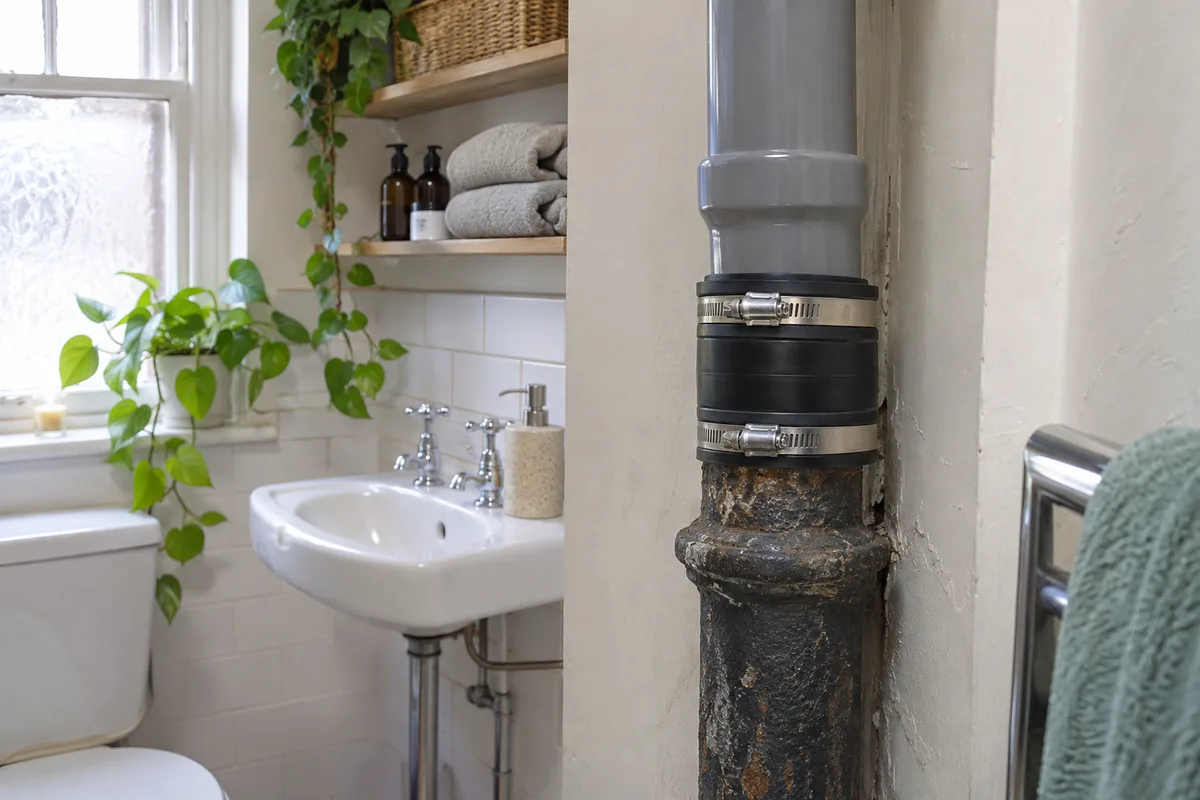
Plastic is lighter and easier to alter, but it carries more sound unless wrapped in acoustic insulation. It also cannot be joined to iron with ordinary fittings. A cast iron stack needs a proper adaptor or coupling, usually a rubber sleeve held by stainless clamps, so that the joint can flex a little and still seal.
We look at what your stack is made from before quoting. If it is old iron, we also look at its condition around the joints. A stack with heavy rust or weeping joints may need a repair by the owners as a group, and that is a conversation for you and your neighbours, not something we can decide.
Connecting a new toilet to the stack
A new toilet connects with a short pipe into the stack or into a branch off it. If your old connection is in the right place, the job is simple: the old pan connector comes out, a new one goes in, and the joint is sealed.
If the toilet outlet sits at a different height or angle, we may need a different connector or a short section of pipe. These parts are flexible, and made for this job. We fit them so the pipe falls gently towards the stack, because a pipe that sits flat or rises will block.
We do not cut or replace sections of a shared stack as part of a bathroom refit unless the owners have agreed it. If a repair is needed, it is better done as a shared job at the right time, with everyone informed.
Why the toilet usually stays near the stack
A toilet waste pipe is wide and needs a steady fall. The further it runs, the more it needs to be lowered, and in a tenement the floor is often too thin to hide a long run. That is why the toilet usually stays close to the stack.
Moving it a short way along the same wall is often possible. Moving it to the other side of the room is much harder, and sometimes not worth the cost. Our article on moving the toilet in a tenement bathroom sets out the options, including when a short move works and when a simpler layout change gives you the same benefit.
Signs the stack needs attention
Slow draining across several fittings at once can mean the stack is partly blocked. Gurgling when someone flushes upstairs, or a smell of drains in the bathroom, can mean the stack is not venting properly. Damp stains around the stack or a drip below a joint need checking quickly.
If water appears on the ceiling of the flat below, our guide on leaks into the flat below shows what to do first. Do not ignore signs just because the pipe is boxed in. A boxed pipe still leaks, and an access panel helps.
Working with the factor and neighbours
If your refit touches the stack, tell your factor and the neighbours before work starts. Explain what is changing, how long the water might be off and who to ring if something goes wrong. Most neighbours are glad to be asked first.
We will explain what we need to do and show you where the stack runs through your bathroom. If you are planning a refit, our tenement bathroom renovation page shows how we plan work in older flats. To talk it over, call us or ask for a free quote.
Guidance reviewed 14 November 2026. Technical and permission requirements depend on the property and proposed work; relevant guidance is linked in the article.